Every security leader buying in this market faces the same three-way choice. Consolidate onto one vendor’s platform suite. Keep best-of-breed scanners and put a correlation layer on top. Or build that layer yourself from open-source tools and a data pipeline. Each is the right answer for some organisations. The mistake is choosing on the demo rather than on the questions that actually separate them.
In short
- Consolidate when tool sprawl and vendor management are the main pain and one suite covers most of your estate well enough.
- Integrate when you already own good scanners, have teams attached to them, and the problem is noise and prioritisation across them.
- Build when you have a strong platform engineering team, unusual requirements and the willingness to own a product indefinitely.
- Whichever you choose, insist on transparent scoring, data that stays exportable, and a measured proof of value on your own code.
The market, named honestly
The vendors below are all credible and each is the right choice for someone. Naming them is more useful than pretending a category has one answer.
Platform suites (code to cloud from one vendor)
Suites are strongest in cloud posture and runtime and are extending into code. Breadth and a single contract are the draw; depth in any one area varies.
Developer-first scanners and AppSec platforms
Strong at finding issues in code and dependencies, with good developer workflow. Most now offer their own prioritisation; correlation across other vendors’ tools is usually weaker.
ASPM and correlation layers
Built to sit across many scanners and decide what matters. They differ in whether they bring their own scanners, how much code context they model, and how open their scoring is.
Where InsightFortify fits: it is an ASPM layer that brings its own open-source engines (Trivy, Opengrep, Gitleaks, Syft, Checkov, ZAP, Prowler, Falco) rather than proprietary ones, accepts output from tools you already run, extends into cloud posture, identities and runtime, and runs inside your own cloud. It is newer and narrower in some areas than the established vendors, and we say so where it matters.
The three paths compared
| Consolidate onto a suite | Integrate: best-of-breed + ASPM | Build your own layer | |
|---|---|---|---|
| Best when | Sprawl and vendor count are the main problem | Good tools exist; noise and prioritisation are the problem | Unusual needs and a strong platform team |
| Time to value | Medium: migration from existing tools | Fast: connect what you have | Slow: months to a usable first version |
| Depth per surface | Varies; rarely best in every area | Best available per surface | Whatever you integrate |
| Correlation across tools | Strong inside the suite, weak outside it | The core purpose | As good as your engineering |
| Lock-in | High: scanners, data and workflow | Moderate: scanners stay replaceable | Low vendor lock-in, high key-person risk |
| Ongoing cost | One large contract | Scanner licences plus the layer | Engineering headcount, indefinitely |
| Who maintains scoring | The vendor | The vendor, ideally transparently | You |
teams rely on?"] -->|"No, or few"| Q2["Is one vendor's coverage
good enough everywhere you care?"] Q1 -->|"Yes"| Q3["Is the pain noise and
prioritisation across them?"] Q2 -->|"Yes"| C["Consolidate"] Q2 -->|"No"| I["Integrate
open-source or chosen scanners
plus an ASPM layer"] Q3 -->|"Yes"| I Q3 -->|"No, it is coverage"| Q2 I --> Q4["Unusual requirements and
a team to own a product?"] Q4 -->|"Yes"| B["Consider building
the layer yourself"] Q4 -->|"No"| I2["Buy the layer"] style C fill:#e0f2fe,stroke:#0369a1 style I2 fill:#ccfbf1,stroke:#0d9488 style B fill:#fef3c7,stroke:#d97706
A rough decision path. Most organisations with an existing tool estate land on integrate.
When building is the right answer
It would be convenient for a vendor to say building is never right. It is sometimes right. Large technology companies with strong security engineering teams have built their own vulnerability data pipelines, and some of them are better than anything on the market for their particular estate. The conditions are specific:
- A platform or security engineering team that can own a product, not a project: ingestion, schema, correlation, scoring, UI, access control and on-call, for years.
- Requirements no product meets: an in-house build system, a proprietary language, unusual data residency rules.
- An existing data platform the pipeline can live on.
Normalising a dozen scanner formats is the easy part. Fingerprinting so duplicates collapse across tools, branches and rescans; keeping KEV and EPSS current; tenant isolation; audit trails; and a UI developers will use are where the time goes.
Budgeted as a team, with a roadmap, an owner and a plan for when the original authors move on. Built on open formats such as SARIF and CycloneDX so it stays replaceable.
Questions that separate vendors
Demos all look alike. These questions do not.
| Question | Why it matters | A good answer |
|---|---|---|
| Show me why this finding is P1. | Unexplained scores lose developer trust | Named factors with their contributions, visible to developers |
| What happens to the same CVE reported by three tools? | Duplicates are the main source of noise | One finding, three sources listed |
| What happens when a fix ships? | Manual closure drifts from reality | The next scan closes it automatically |
| Can I export everything, including history? | Lock-in and audit evidence | Full API; open formats |
| Where does my code go? | Source code is sensitive IP | Clear answer: stays in my cloud, or exactly what is sent where |
| What do you send to an LLM, and can I turn it off? | AI features can leak code | Configurable per organisation; code off by default |
| How is one tenant’s data isolated from another’s? | Multi-tenant failures are severe | Enforced in the database, not only in application code |
| Run it on two of my repositories and one cloud account. | Your estate is not the demo estate | A measured raw-to-actionable funnel on your own code |
What we can show you on that last question
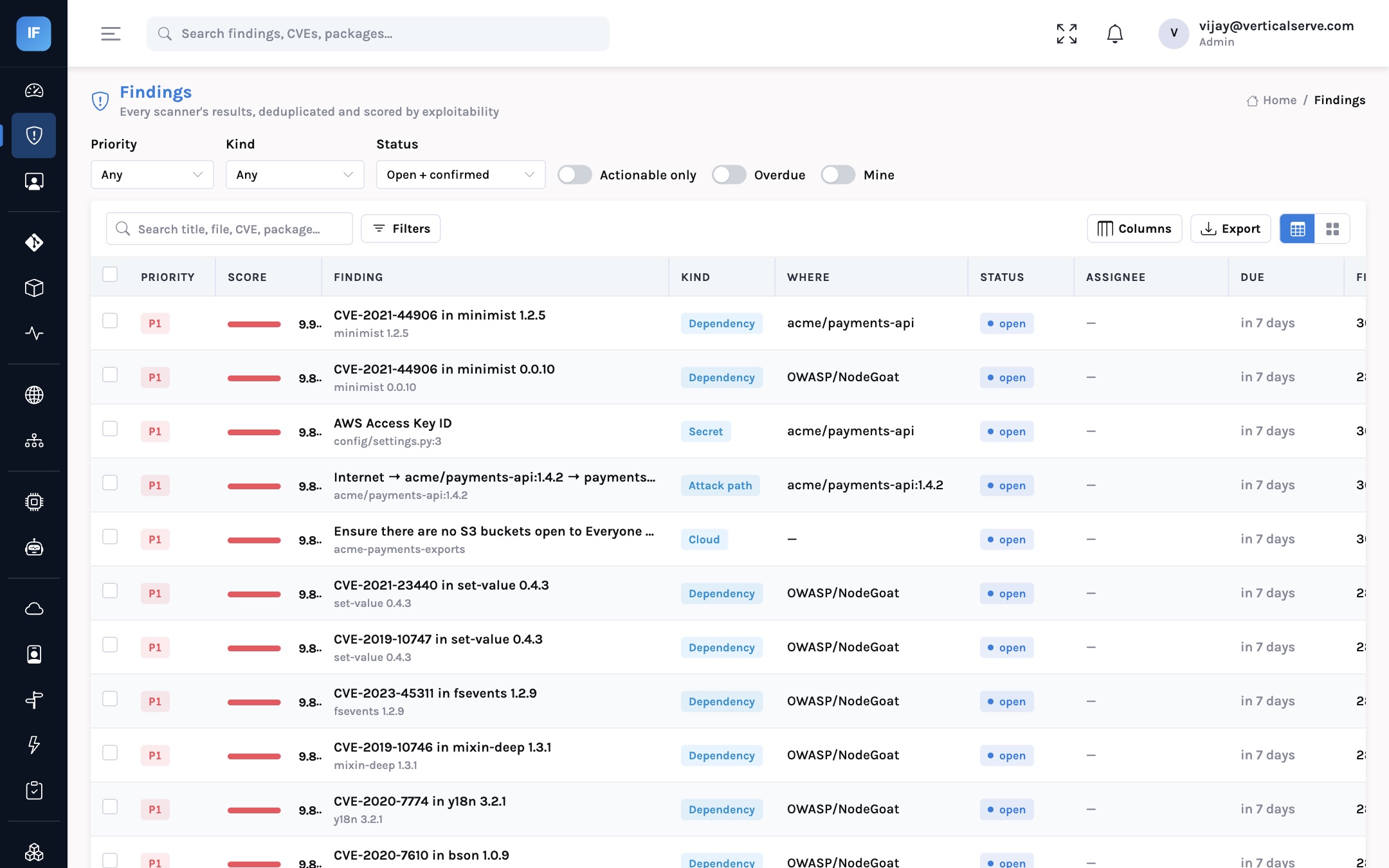
On our own demo estate, InsightFortify reduced 382 raw results to 287 unique and 131 actionable findings, and OWASP NodeGoat alone from 340 raw to 80 actionable. Those are our numbers on public test code. Any vendor, including us, should be asked to produce the same funnel on yours.
Evaluating in practice
Two to five repositories of different languages, one container image pipeline, one cloud account. The same for every vendor.
What your current tools report on that scope, in total.
Measure raw, unique and actionable counts, and time to first useful result.
Would they fix these, in this order? Is the reason clear?
Export all findings with history via the API. Check the format is usable.
Weight by your situation: lock-in, depth, time to value, cost.
Typical positions, not rules. A suite you already own can be fast; a build on an existing data platform can be quicker than shown.
For the CISO
The decision is about where you want lock-in and how much engineering you want to own, not about features.
Insist on a measured funnel on your own code before signing.
For the AppSec lead
Ask every vendor the eight questions. Have developers review the top ten findings from each.
Prefer open formats (SARIF, CycloneDX) so today’s choice stays reversible.
For the board
Consolidation saves contracts; integration saves time; building saves neither unless you have the team.
Ask what happens if you want to leave in three years.
There is no universally right platform. There is a right answer to: where is our pain, what do we already own, and what will we maintain?
Answer those three, then make every candidate prove itself on your own code.